Supported staff, safer systems: The case for strong safety culture

By Milissa Eagle, MA, Director of Workforce Analytics, Press Ganey.
Why safety culture matters: Safety as a key driver of engagement
In healthcare, engagement doesn’t start with job titles, recognition programs, or pay. It begins with the confidence that both you and your patients are safe. Safety culture is the shared assurance that team members can speak up, rely on each other, and work without fear—physically, emotionally, or psychologically—while also knowing that the systems around them will support and protect them and the people they care for.
Seven of the 10 strongest drivers of engagement across the healthcare workforce are tied directly to safety culture. When healthcare employees describe what keeps them committed to their work, they rarely talk about organizational slogans or strategic plans. They talk about whether they can count on their team in a crisis. Whether they’ll be heard if they flag a concern. Whether resources will be there when a shift becomes unmanageable. Whether leaders will protect them—not just in words, but in action.
Safety culture isn’t abstract. It is lived through hallway conversations after a near miss, in the decision to speak up during a tense moment, and in the confidence in knowing that leadership will back staff if something goes wrong. These small daily experiences accumulate in trust. And that trust fuels engagement.
When employees believe their organization is committed to safe working conditions, teamwork, and accountability, they lean in. Our research shows that when teams report there is a climate of trust in their unit, they are 2.4x more likely to be top performing on the patient experience measure, and 2.1x more likely to be top performing on patients’ perceptions of staff working together. They contribute more, communicate more openly, and feel that their work has meaning. And that sense of meaning is something patients feel immediately—in the attentiveness of a bedside conversation, the calm confidence during a complex procedure, or the empathy during a difficult discussion.
A best practice approach to safety culture measurement
With so much riding on safety culture, healthcare organizations require accurate, reliable solutions to collect and report safety data to key stakeholders across the system. Press Ganey partners with healthcare providers to get an in-depth understanding of how front-line staff, patients, and physicians/APPs perceive the safety culture within their systems. Our Safety Culture survey includes 19 scientifically validated questions covering three core dimensions:
- Prevention & Reporting
- Pride & Reputation
- Resources & Teamwork
Organizations can elect whether to deliver the safety survey as a standalone survey, or as a subset of questions included in the comprehensive Workforce Census survey. Once the survey window has closed, results are reported in real time via Press Ganey’s Human Experience (HX) platform, which features a Safety Culture summary page to emphasize the organization’s commitment to safety. Most importantly, we offer hands-on advisory support and in-depth consulting solutions to help organizations take meaningful actions based on the insights surfaced from the data.
Because Press Ganey’s Safety Culture survey is a valid, robust way to measure and report mission-critical metrics, it can also be used support other existing safety initiatives including:
- The LeapFrog Group Hospital Survey (Tier 3)
- CMS Hospital Patient Safety Structural Measure (PSSM)
- Joint Commission Safety Culture
3 early takeaways from Press Ganey’s ‘State of Healthcare Safety 2026’ report
In addition to working in lockstep with our client partners to help them understand what their safety culture data means for them, our team of advanced-degree researchers regularly zooms out to see the bigger picture—using Press Ganey’s robust industry benchmarks to further contextualize findings. While Press Ganey’s “State of Healthcare Safety 2026” report gives a deep dive into the data, I wanted to highlight a few of the biggest headlines for Employee Experience professionals:
1. People stay when it’s safe
The emotional experience of safety—feeling protected, supported, and heard—doesn’t just influence how people show up to work, but whether they stay.
Employees who hold unfavorable perceptions of safety culture are 1.74x more likely to leave their organization, based on our latest report. This means every time safety feels compromised—short staffing, communication breakdowns, an environment where reporting feels unsafe, as examples—the organization is more at risk for turnover. And turnover is not just a staffing issue. It is a patient care issue.
When staff leave, care teams lose their rhythm. Continuity breaks. Workload rises for those who remain. And patients inevitably feel the decline: longer waits, less consistency, more variability in the care experience.
Safety culture is the stabilizing force that prevents that spiral. When safety feels strong, people stay. They build deeper relationships with colleagues. They become the steady, familiar presence patients rely on when feeling vulnerable.
2. Safety culture perceptions are rising, but vary by role
Across the industry, safety culture perceptions have begun to rebound after several years, with improvements in teamwork, reporting, and overall safety perceptions. But, while there have been improvements, nearly half (46.6%) still feel their organization doesn’t have a strong safety culture.
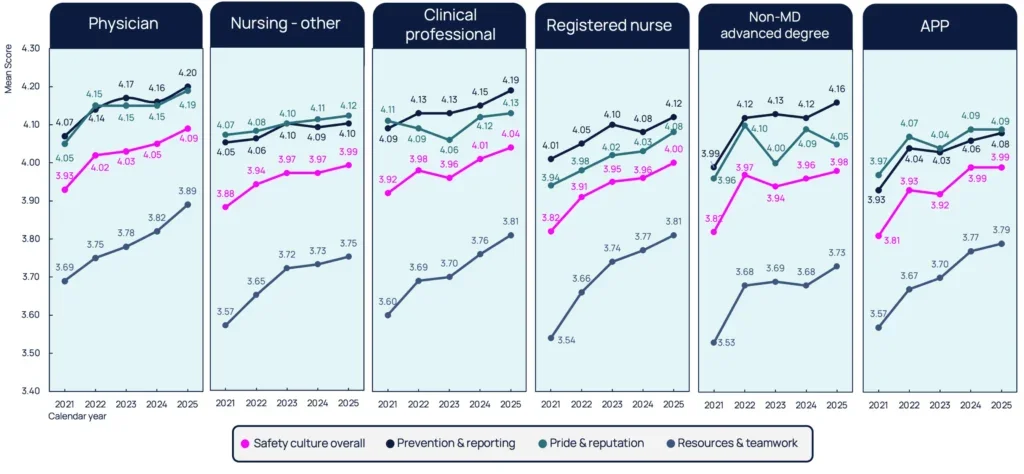
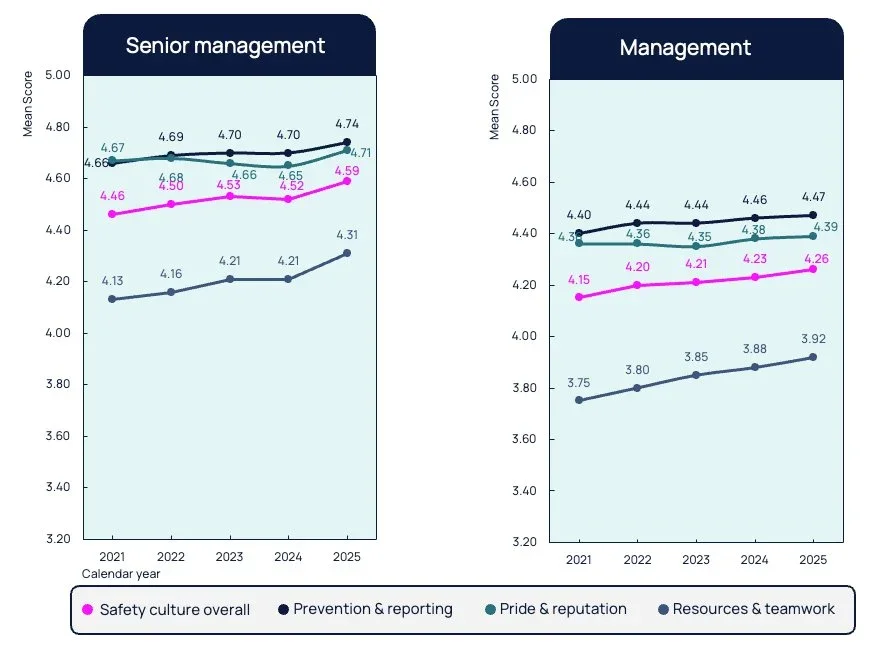
This sentiment varies by role. Frontline caregivers—those whose hands, voices, and actions patients depend on most—continue to report lower perceptions of safety culture than leaders and non-direct care roles.
Safety culture by clinical role
Safety culture by leadership role
Within the clinical roles, Advanced Practice Providers show flat, year-over-year safety culture scores, suggesting, not deterioration, but stagnation—a quiet signal of unmet needs.
Meanwhile, leaders’ perceptions tend to be more positive and stable. Their experience of safety often reflects system design, while the frontline experience reflects system execution. When those two perspectives become asynchronous, blind spots begin to form. The people shaping strategy start to believe conditions are safer than those delivering care experience. The disconnect affects everything from psychological safety, to reporting, to the willingness of staff to escalate concerns.
Safety culture trends by role tell us where trust is strong, where it is thinning, and where it is at risk of breaking. And because patient outcomes depend so heavily on teamwork, communication, and rapid escalation, these gaps can influence the patient experience.
3. The foundation of employee and patient experience lies within safety culture
Across engagement, retention, and role-specific trends, one message emerges: Safety culture is the foundation on which every part of the employee and patient experience is built. When safety feels strong, employees are more connected, more committed, and more present with their patients. When safety falters, the entire care environment feels less steady—both for the people delivering care and the people receiving it.
If the healthcare workforce is the heart of the organization, safety culture is its pulse. And listening closely to that pulse—by role, by shift, by lived experience—is how organizations protect their people, retain their talent, and ultimately deliver the kind of care patients trust.
Keeping safety at the center of your people strategy
From capturing the data to getting it into the right hands at the right time to drive meaningful action, improving safety culture can feel like a daunting task without the right tools and resources. Check out the full report for a detailed run-down of our benchmarking data, including actionable recommendations, and reach out to one of our experts to learn more about how Press Ganey partners with leading healthcare systems to drive safety culture improvements.